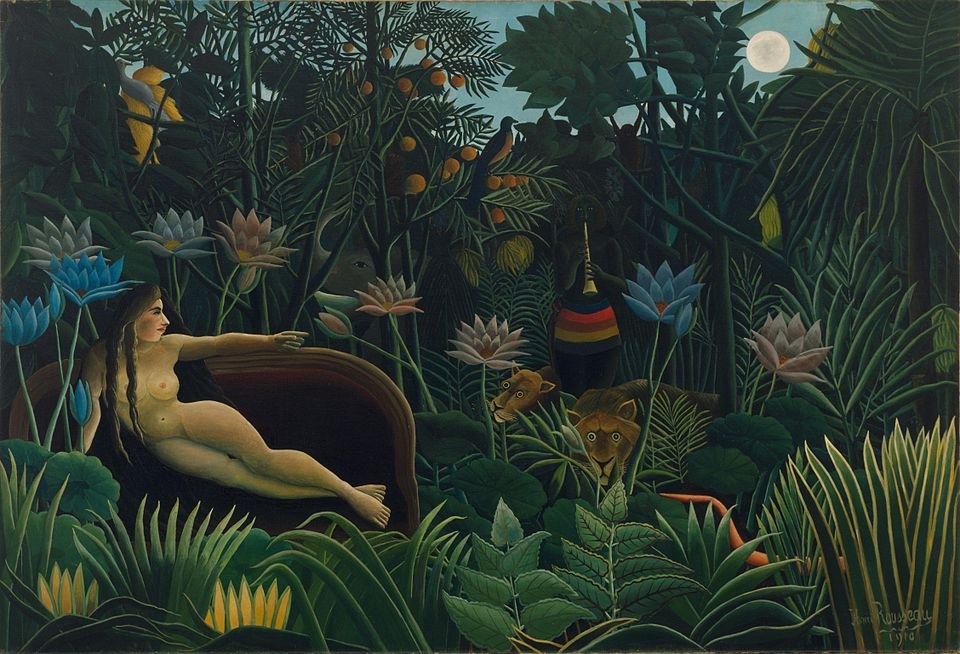
Rousseau's final major painting depicts a nude woman — Yadwigha, a Polish lover from his youth — reclining on a velvet sofa that sits, inexplicably, in the middle of a dense jungle teeming with lions, exotic birds, and a snake charmer emerging from the undergrowth. The collision of the domestic and the wildly foreign is total and unapologetic: Rousseau offered no justification for the sofa's presence in the jungle, saying simply that the woman was dreaming herself there. Completed the year of his death and exhibited at the Salon des Indépendants to considerable acclaim, it is widely considered the culminating statement of his visionary imagination.
about the artist
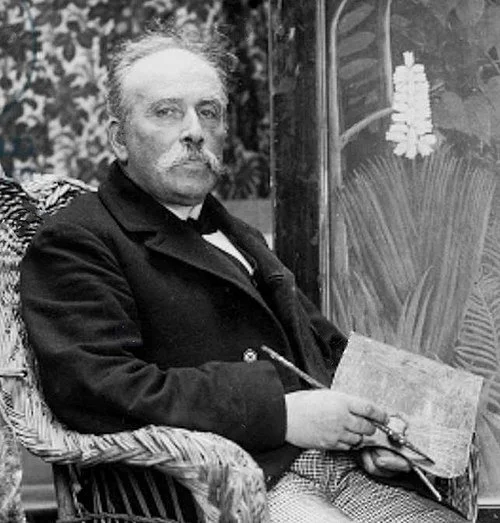
Henri Rousseau was a self-taught French painter who only began painting seriously in his early forties, submitting work to the Salon des Indépendants from 1886 onward, where it was often met with ridicule from critics who found his naive style primitive and technically deficient. Picasso, Apollinaire, and other avant-garde figures recognized something altogether different in his work and championed him; today his distinctive vision is understood as one of the founding expressions of naïve art and a significant influence on twentieth-century modernism.
Henri Rousseau
The Dream, 1910
Oil on canvas