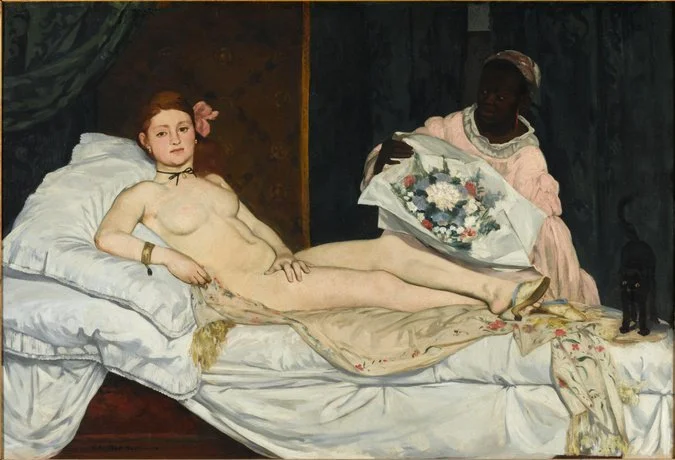
When Olympia was exhibited at the Paris Salon of 1865, it caused a scandal not merely because of its nude subject but because of how that subject was rendered: a pale, flat figure meeting the viewer's gaze with absolute directness, accompanied by a Black maidservant holding flowers — almost certainly from an admirer — and a black cat at the foot of the bed. Manet's deliberate reference to Titian's Venus of Urbino underlined the provocation: where Titian's Venus is reclining and available, Olympia is a named individual who returns the gaze on her own terms. The painting is now understood as a landmark in the representation of the modern female subject.
about the artist
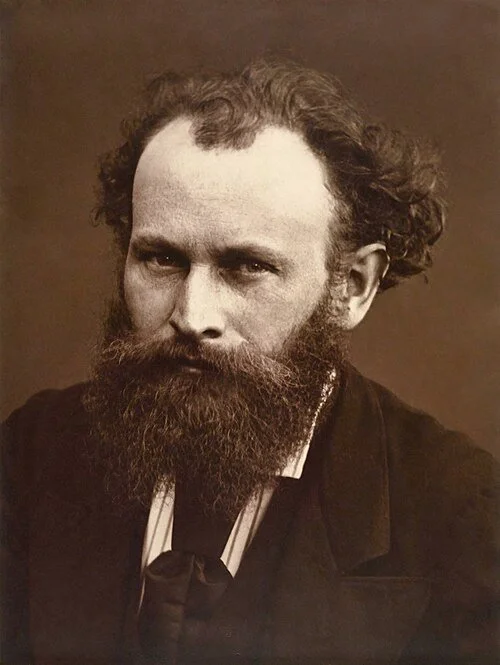
Édouard Manet occupies a pivotal position in art history as the figure who bridges the academic tradition and the Impressionist revolution, without quite belonging fully to either. Born in Paris in 1832 into a prosperous bourgeois family, he trained under Thomas Couture but quickly developed a style characterized by flattened forms, bold tonal contrasts, and an unflinching attention to contemporary urban life. He was deeply influenced by Velázquez and Goya, whose directness and painterly economy he absorbed into a vision of modern Paris that the Impressionists — especially Monet and Degas — took as a point of departure.
Édouard Manet
Olympia, 1863
Oil on canvas