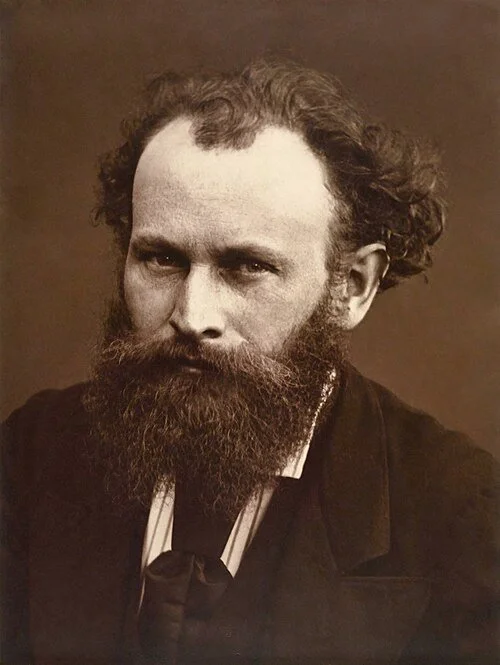

Édouard Manet
Luncheon on the Grass, 1863
Oil on canvas
Rejected from the official Salon, this painting was shown at the famous Salon des Refusés of 1863, where it caused a scandal that eclipsed almost everything else on display: a nude woman sits casually in a forest clearing with two fully dressed men, turning to face the viewer with neither shame nor explanation. Manet derived the composition directly from a Raphael engraving and a Titian painting, making his transgression deliberate — he was not naive about conventions but openly testing them. The flatness of the figures, the lack of atmospheric depth, and the jarring juxtaposition of the undressed woman with her clothed male companions signaled a rupture with academic painting that would define the next fifty years.
about the artist
Édouard Manet occupies a pivotal position in art history as the figure who bridges the academic tradition and the Impressionist revolution, without quite belonging fully to either. Born in Paris in 1832 into a prosperous bourgeois family, he trained under Thomas Couture but quickly developed a style characterized by flattened forms, bold tonal contrasts, and an unflinching attention to contemporary urban life. He was deeply influenced by Velázquez and Goya, whose directness and painterly economy he absorbed into a vision of modern Paris that the Impressionists — especially Monet and Degas — took as a point of departure.